






Blog
Two-Phase Cooling Design for AI Datacenters with GT-SUITE Scientific AI

Overview
The year 2026 manifests the frequently discussed trend of fast increasing rack power density for AI datacenters. With NVIDIA’s 120kW GB200NVL72 rack well established, GB300 racks with 140kW in large scale production, and next generation racks like NVIDIA’s Vera Rubin NVL72 or AMD’s Helios MI455 entering the market. While for the new incumbents clean single rack power numbers are not yet public, they are often estimated at 200kW or higher. Both racks rely on direct liquid chip cooling but especially the AMD Helios is a good indication for the challenges ahead for single phase liquid cooling at increasing power densities. It uses Meta’s OCP Open Rack Wide spec that is specifically designed to address AI infrastructure requirements, for example giving more space for large cooling manifolds and other equipment at the cost of an increased footprint.
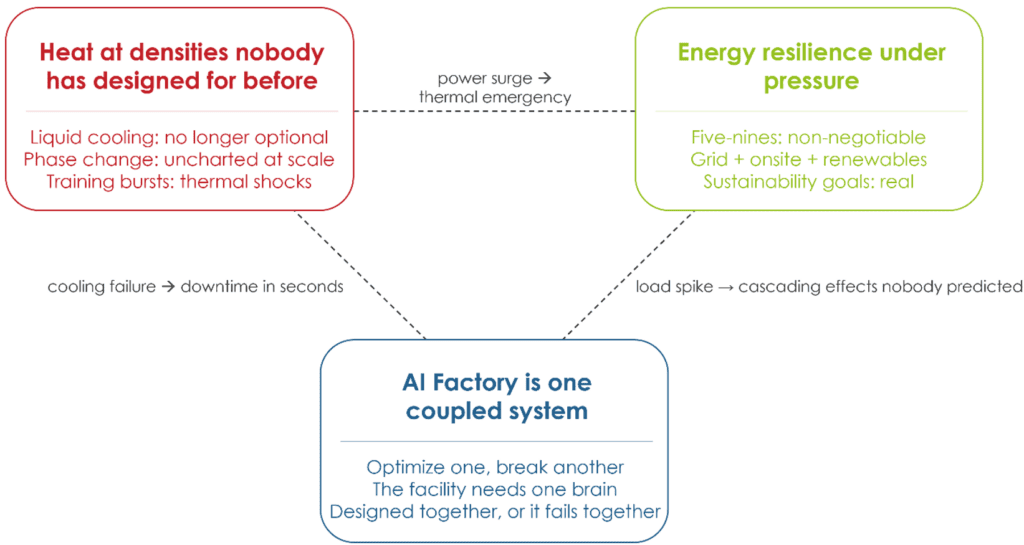
With its multiphysics and multidomain simulation technology GT-SUITE helps users push their single phase liquid cooling concepts to the edge, but it cannot help to push beyond the edge of physics or economic reality. To further increase single phase heat flux, requires increasing velocity, decreasing microchannel size, or lowering the coolant temperature. Measures that either vastly increase pressure losses or limit the ability to leverage free cooling at the facility.
This post covers how two-phase chip cooling addresses these limits and why refrigerant selection and blending make two-phase design harder to simulate. It then explains how a neural-network surrogate for refrigerant thermodynamic properties delivers an average 60x speedup over direct equation-of-state calls, fast enough to sweep fluid composition inside a single coupled thermal-flow simulation.
Two-phase chip cooling. A solution for Next Generation Datacenters
Two-phase chip cooling is discussed as a feasible option to overcome many of the challenges that single phase cooling poses at the rack level. Using the boiloff of the fluid phase change concepts are promising high heat flux at the chip, and can also enable raising the coolant temperature thereby making heat reuse or free cooling more attractive.
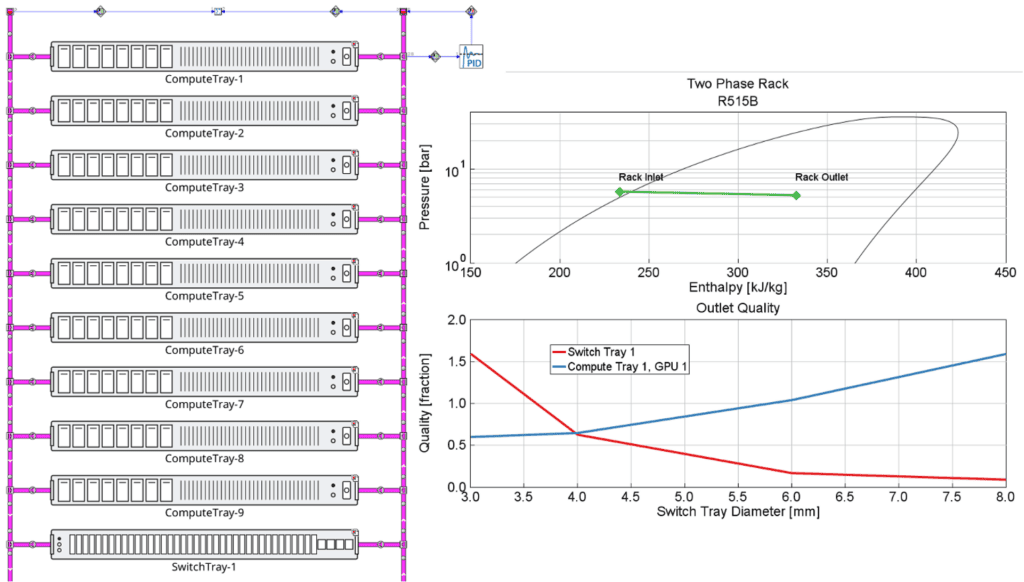
This can be nicely exemplified when looking at water. Even when assuming a 20K temperature rise for a single phase coldplate, the heat absorbed per kilogram of water is 80 kJ/kg. For phase change it is around 2300 kJ/kg, 30 times higher, and while water is likely not to be the phase change fluid seeing mass adoption first, it shows the potential of this technology.
Instead of water, technical solutions usually leverage a range of highly engineered fluids. Then understood in context with the rack and facility cooling systems, those fluids constitute an important optimization potential of the entire cooling concept, but they are not without challenges. While an excessive global warming potential of earlier fluid types such as R-245fa and HFE-7000 has been addressed by the introduction of R-1233zd(E) or R-1336mzz(Z), the latter of which are probably not considered PFAS-free under broad PFAS definitions discussed for regulatory constraints. This, together with component and system optimization potential, motivates continued development of these fluids.
GT-SUITE provides the perfect virtual testing ground not only for development of the two-phase-based cooling solution on facility and rack levels. It also allows testing of fluids and fluid mixtures in versatile scenarios leveraging scientific AI.
GT-SUITE Scientific AI for Refrigerant Mixing
Experimenting with two-phase fluids and their mixtures is often not only complex and time-consuming in physical testing but also in simulation because of the complex nature of the equation of state.
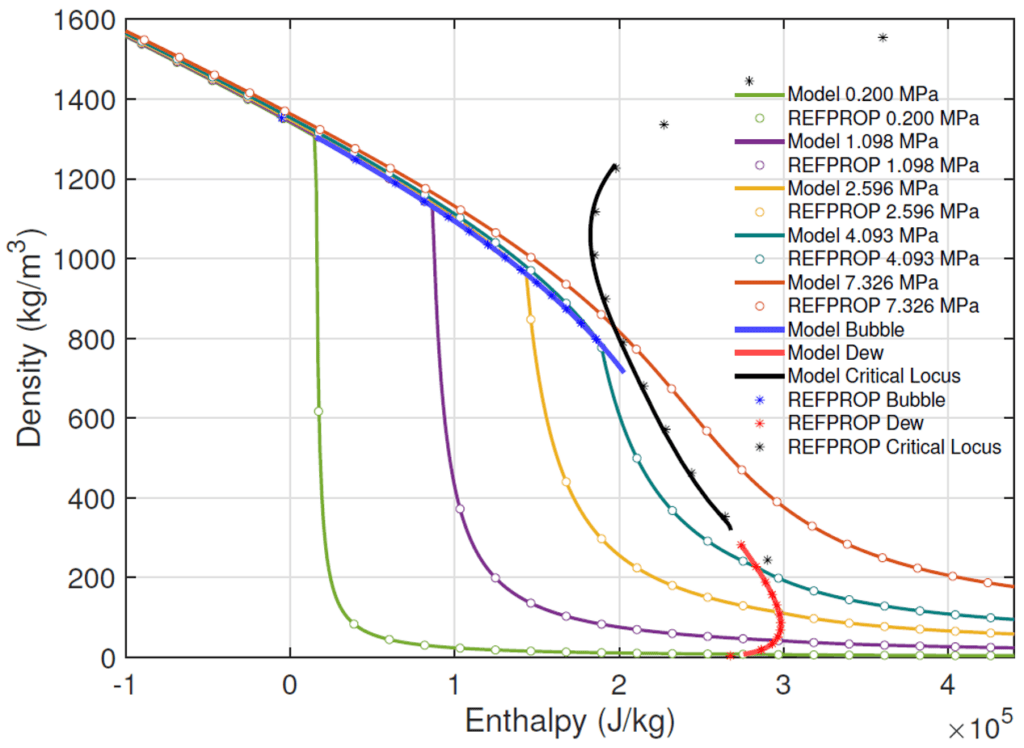
GT-SUITE’s Scientific AI addresses this directly with a fast neural-network surrogate that reproduces reference-grade thermodynamic data (e.g. REFPROP) for multicomponent refrigerant blends across liquid, vapor, two-phase, and near-critical conditions. By training the two-phase formulation so that vapor quality automatically satisfies the correct bubble- and dew-line limits, the surrogate returns continuous, physically consistent properties everywhere in the domain, including the near-critical region where conventional equation-of-state solvers are most prone to slow convergence or numerical noise. In benchmark testing, this reduces property evaluation to microsecond-scale calls, delivering an average 60x speedup over direct equation-of-state calls. That speed and robustness are what make large-scale exploration practical: composition, pressure, and operating point can be swept continuously inside a single coupled thermal-flow simulation instead of relying on a limited set of precomputed cases, so tools like GT’s Integrated Design Optimizer can search the full Pareto front among latent heat, pressure drop, charge, and GWP in realistic run times.
What Scientific AI in GT-SUITE enables
Composition as a design/optimization axis. Instead of running separate precalculated cases of fluid compositions, you can sweep composition continuously inside one coupled thermal+flow simulation and have GT’s Integrated Design Optimizer (or your own DOE) find the Pareto front among latent heat, pressure drop, charge, GWP, and flammability class.
Screen different fluids and blend options. Instead of testing a limited number of fluid options in hardware or slow high-fidelity simulation, virtual simulation in GT allows you to screen a large number of fluids and blend compositions for critical factors such as critical heat transfer margin from simplified component models or assess PUE savings potentially by chaining chip → die contact → TCS loop → CDU/heat exchanger → facility water/economizer → ambient in a comprehensive system model.
Study transient and off-design behavior. Blend composition is not guaranteed to be constant. It can change as a result of partial charge loss, flowrate imbalances and heat input. Transient and coupled simulation in GT-SUITE allows you to simulate these transient scenarios like startup, charge loss or load steps, subsequently assessing your refrigerant under conditions that can be difficult, sometimes even dangerous to reproduce on hardware.
Taken together, GT-SUITE Scientific AI gives providers of AI datacenter cooling solutions a faster, more confident path through the two-phase cooling design space: fluid and blend screening, system-level trade-off studies, and transient risk assessment all run in the same coupled model, at simulation speeds that make full Pareto exploration practical rather than theoretical. The result is fewer physical test iterations, earlier identification of viable fluid and hardware combinations, and design decisions grounded in reference-grade thermodynamic accuracy, letting teams keep pace with the rapid rise in rack power density instead of being limited by it.
Ready to push your two-phase cooling designs further? Contact our datacenter team to see GT-SUITE in action. Follow our LinkedIn channel to stay updated on the latest advancements in our solutions and subscribe to the GT blog to receive updates on new AI capabilities, engineering solutions, and industry trends.
Frequently Asked Questions
1. What is GT-SUITE Scientific AI for refrigerant modeling?
It is a fast neural-network surrogate that reproduces reference-grade thermodynamic data (such as REFPROP) for multicomponent refrigerant blends across liquid, vapor, two-phase, and near-critical conditions. It delivers an average 60x speedup over direct equation-of-state calls, so composition can be swept inside a single coupled thermal-flow simulation.
2. Why is two-phase chip cooling considered for next generation datacenters?
As rack power density rises, single phase liquid cooling hits limits in velocity, microchannel size, and coolant temperature. Two-phase cooling uses the heat of vaporization to absorb far more heat per kilogram of fluid. It can also allow higher coolant temperatures, which makes heat reuse and free cooling more attractive.
3. What can engineers do with GT-SUITE Scientific AI in two-phase cooling design?
Engineers can treat fluid composition as a design axis and use GT’s Integrated Design Optimizer to find the Pareto front among latent heat, pressure drop, charge, GWP, and flammability class. They can also screen many fluids and blends, and study transient and off-design behavior such as startup, charge loss, and load steps.